
Bangkok Beyond Temples – 10 Places Locals Know But Tourists Rarely See
Bangkok rarely needs an introduction. The Thai capital appears in almost every Southeast Asia itinerary, often summarized through a predictable checklist: ornate temples, night markets, tuk-tuk rides, and street food. Those landmarks deserve their reputation, but they also overshadow another version of the city—one that unfolds quietly behind university hospitals, local food alleys, art centers, and neighborhood parks.
Approach Bangkok like a planner rather than a tourist, and the map shifts immediately. Instead of simply moving from temple to temple, you begin to notice places where the city reveals its habits: where locals buy flowers before sunrise, where students gather for exhibitions, or where collectors preserve decades of childhood toys.
Travel writers often describe destinations through emotion—wonder, surprise, nostalgia. Yet experienced travelers also know that the most memorable places often feel slightly unconventional. The following ten locations represent that side of Bangkok. None of them compete with the Grand Palace in scale, yet each contributes a piece of cultural texture that typical itineraries overlook.
Quick Summary Table
| Location | Type | What Makes It Interesting |
|---|---|---|
| Siriraj Medical Museum | Medical history museum | Rare medical exhibits and forensic collections |
| Pak Khlong Talat Flower Market | Market | Bangkok’s largest and most colorful flower market |
| Wang Lang Market | Street food market | Affordable local food near the river |
| Khlong Thom Market | Chinatown market | Unique second-hand and unusual items |
| Sub-Zero Ice Skate Club | Ice skating & nightlife | Skating rink transforming into evening club |
| Bangkok Art and Culture Centre | Cultural venue | Contemporary art exhibitions and creative spaces |
| Bangkok Airways Blue Ribbon Screen | Luxury cinema | Premium movie theater experience |
| House of Museum | Historical home museum | Displays everyday Thai household objects |
| Batcat Toy Museum | Toy museum | Over 50,000 toys from different eras |
| Rama IX Park | Urban park | The largest green space in Bangkok |
1. Siriraj Medical Museum
Across the river from Wat Pho sits one of the city’s most unusual museums. The Siriraj Medical Museum is often nicknamed the “Museum of Death,” which explains why it rarely appears on casual tourist itineraries.
Inside the museum complex are collections related to anatomy, pathology, and forensic medicine. Preserved medical specimens, displays of human organs affected by disease, and historical crime cases are presented for educational purposes. One of the most talked-about exhibits includes the preserved body of a notorious serial killer executed in the twentieth century.
It is not a lighthearted visit. However, for travelers interested in medical history or forensic science, the museum offers a rare perspective on Thailand’s healthcare history and scientific research.
Travel planners often suggest pairing the visit with a riverside walk afterward—the contrast helps reset the mood.
2. Pak Khlong Talat Flower Market
If the previous stop feels unsettling, the next destination restores balance with color and fragrance.
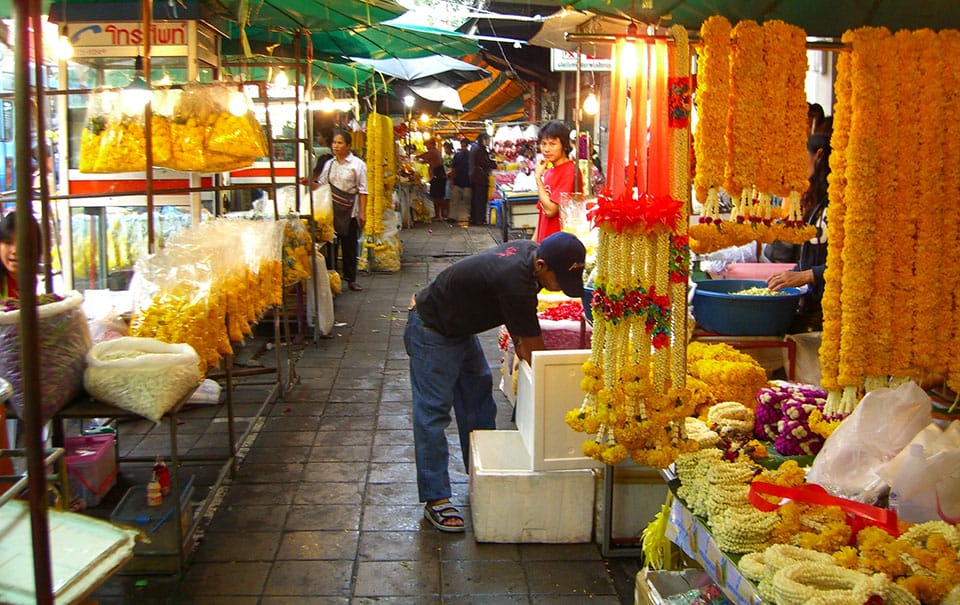
Pak Khlong Talat is Bangkok’s primary wholesale flower market. Arrive early in the morning and the area resembles a moving garden. Trucks unload orchids, roses, jasmine garlands, and marigolds destined for temples and ceremonies across the city.
For photographers and travelers interested in everyday life, this market reveals the rhythm of Bangkok before sunrise. Vendors weave flower garlands while customers negotiate bundles destined for weddings or religious offerings.
The market also illustrates something important about Thai culture: flowers are not decorative luxuries—they are everyday symbols used in worship, celebration, and hospitality.
3. Wang Lang Market
Located near the river and close to local universities, Wang Lang Market operates as an informal culinary playground.
Here, stalls sell a dense variety of Thai street food—snacks, sweets, grilled dishes, and quick meals that locals pick up between classes or during lunch breaks. The environment feels casual, crowded, and lively.
Unlike curated food courts, Wang Lang still functions as a neighborhood market. Travelers often find dishes here that rarely appear in hotel restaurants. Exploring slowly—stall by stall—becomes part of the experience.
Food-focused travelers frequently say that this market represents Bangkok at its most authentic: quick, flavorful, and always busy.
4. Khlong Thom Market
Most travelers associate Bangkok markets with the famous Chatuchak Weekend Market. But deeper inside Chinatown lies Khlong Thom Market, a place that feels less curated and more unpredictable.
Vendors here specialize in unusual merchandise—second-hand tools, mechanical parts, vintage electronics, and odd collectibles. The market’s reputation comes from the possibility of discovering unexpected items.
Think of it as Bangkok’s version of a curiosity market rather than a typical souvenir destination.
5. Sub‑Zero Ice Skate Club
Bangkok’s tropical climate rarely suggests ice skating. That contrast is exactly what makes Sub-Zero interesting.
Located on the fourth floor of the Esplanade Shopping Center in the Ekkamai area, the venue functions as an indoor skating rink during the day.
At night, the atmosphere changes. DJs play music while skaters perform routines under colored lights, transforming the rink into something closer to a nightclub environment.
For travelers escaping Bangkok’s heat, the sudden shift from tropical humidity to frozen air feels almost surreal.
6. Bangkok Art and Culture Centre
Opened in 2008, the Bangkok Art and Culture Centre serves as one of the city’s most active contemporary art spaces.
Inside the spiraling gallery structure are rotating exhibitions featuring Thai and international artists. The complex also includes cafés, bookstores, small design shops, and reading spaces.
This venue offers a glimpse into Bangkok’s creative community. Students, photographers, and designers frequently gather here, turning the building into a cultural meeting point rather than just a museum.
7. Bangkok Airways Blue Ribbon Screen
Inside the Paragon Cineplex is a cinema experience designed more like a lounge than a traditional theater.
The Blue Ribbon Screen provides large reclining seats, attentive service, and a quiet atmosphere designed for comfort. Watching a film here becomes part entertainment, part relaxation ritual.
For travelers spending multiple days in Bangkok, this kind of stop can feel surprisingly refreshing—especially after long days of sightseeing.
8. House of Museum
House of Museum focuses on nostalgia rather than spectacle.
This small museum displays household items used by Thai families in previous decades—kitchen tools, radios, furniture, toys, and everyday objects that once filled ordinary homes.
It is located in a quiet area and opens primarily on weekends, which contributes to its low profile among tourists.
Yet that modest scale also gives the museum its charm. Visitors often describe it as stepping into a living memory rather than a formal exhibition.
9. Batcat Toy Museum
If House of Museum revisits domestic life, Batcat Toy Museum revisits childhood.
With more than 50,000 toys, the collection spans decades—from vintage action figures to modern pop-culture collectibles. It is considered the largest toy museum in Thailand and among the largest in the world.
For collectors and nostalgia enthusiasts, the museum becomes an unexpectedly emotional stop.
10. Rama IX Park
After exploring museums and markets, Rama IX Park offers a quiet reset.
Covering 200 acres, it is Bangkok’s largest green space. Built in 1987 to commemorate the 60th birthday of the Thai monarch, the park includes lakes, gardens, and themed landscapes.
One highlight is the international garden section, where landscape designs from several countries appear side by side.
For travelers spending several intense days in Bangkok’s dense streets, the park provides something rare in the capital: space.
Things the Media Doesn’t Tell You
Most travel coverage simplifies Bangkok into a sequence of famous landmarks. But planning a deeper visit reveals several practical realities:
1. Some unusual attractions are intentionally uncomfortable.
Places like Siriraj Medical Museum are educational rather than entertaining. They are meant for serious curiosity, not casual sightseeing.
2. Markets change dramatically by time of day.
Flower markets operate at their most vibrant before sunrise. Arriving late means missing the most interesting activity.
3. Small museums often have limited schedules.
Locations like House of Museum may open only on weekends, which requires planning.
4. Bangkok’s “hidden” attractions are rarely isolated.
Most sit within everyday neighborhoods—university districts, shopping centers, or residential areas.
Seasoned travel writers often emphasize this principle: the best discoveries happen when travelers shift from sightseeing to observing daily life.
Bangkok rewards that approach.
Community Notes From Travelers
“The flower market before sunrise feels like watching Bangkok wake up.”
“The medical museum is intense but fascinating if you enjoy forensic history.”
“Batcat Toy Museum surprised me—I spent two hours there without noticing.”
Bangkok Hidden Corners – From Medical Museums to Midnight Flower Markets.
Bangkok hidden attractions, Bangkok unusual places, Siriraj Medical Museum, Pak Khlong Talat market, Wang Lang street food, Bangkok toy museum, Rama IX Park Bangkok, Bangkok art culture centre, Bangkok Chinatown markets, Bangkok offbeat travel, Bangkok alternative itinerary, Bangkok cultural attractions, Bangkok local markets, Bangkok travel planner, Bangkok unique experiences
