There are places that impress you. And there are places that follow you home. Ha Tien belongs stubbornly to the second category. It does not dazzle in the loud, billboard sense of modern tourism. Instead, it seeps into you, quietly, persistently, like a half remembered poem that resurfaces when you least expect it.
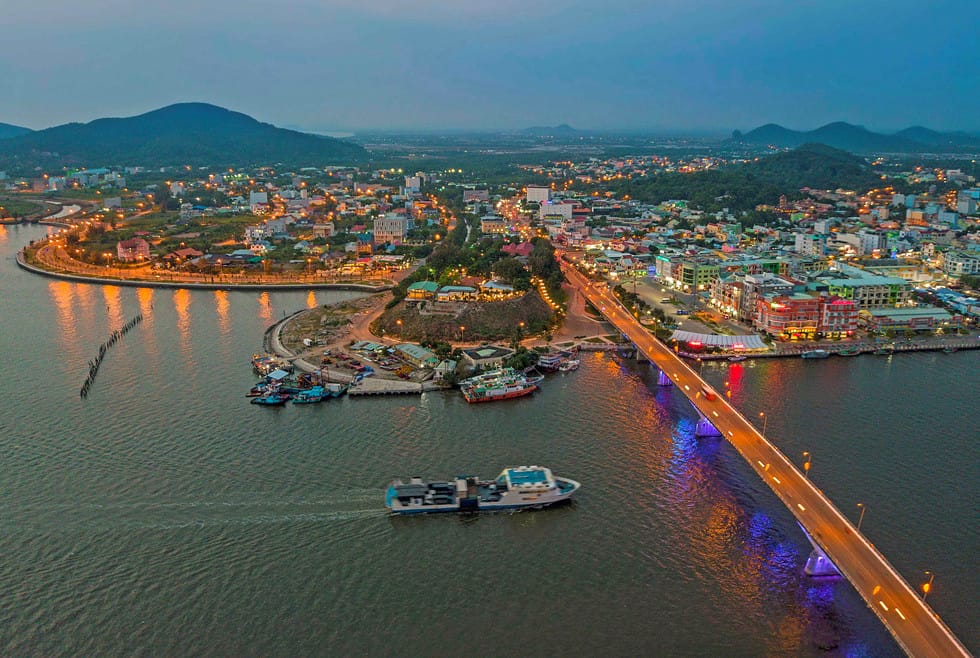
Ha Tien lies at Vietnam’s southwestern edge, in Kien Giang Province, where land exhales into the Gulf of Thailand and history never quite learned how to leave. Centuries ago, the scholar governor Mac Thien Tich immortalized this borderland in verse, naming ten scenes so vivid they felt less like descriptions and more like vows. Time, weather, and human impatience have taken their toll. Five of those scenes remain intact in spirit. And that is enough. More than enough.
This is not a destination for checklist travelers. This is a place for walkers, listeners, people who pause mid sentence because the view interrupts them.
The journey to Ha Tien already feels like a soft departure from the obvious. From Rach Gia, the road glides through flat, watery countryside, past rice fields and wind bent palms. By the time you cross the To Chau Bridge, Ha Tien reveals itself not as a town but as a threshold. Cambodia is near. The sea is nearer. The past is very close indeed.
Binh San Hill is where Ha Tien begins to speak in a lower voice. Known poetically as Binh San Diep Thuy, the hill rises gently, only fifty three meters, but authority has never depended on altitude. This is the resting place of the Mac family, founders of Ha Tien, visionaries who understood that border towns survive not by walls but by culture.
Climbing Binh San is less exertion than meditation. Flowers bloom without announcement. Wind moves carefully. From the summit, Ha Tien unfurls below like an old scroll painting. Rivers, rooftops, distant sea. It is the sort of view that makes you recalibrate your ambitions. You see how small the town is. You see how complete it feels.
A short walk away, Tam Bao Pagoda continues the conversation in silence. Built by Mac Cuu for his mother, the pagoda carries the name Tieu Tu Than Chung, the sacred bell in a quiet temple. Bells once rang here across misty mornings. Today, the architecture has evolved, but the mood remains untroubled. A bronze Amitabha Buddha stands serenely, while an open air Avalokiteshvara watches the courtyard with practiced compassion. Travelers often lower their voices without realizing why.
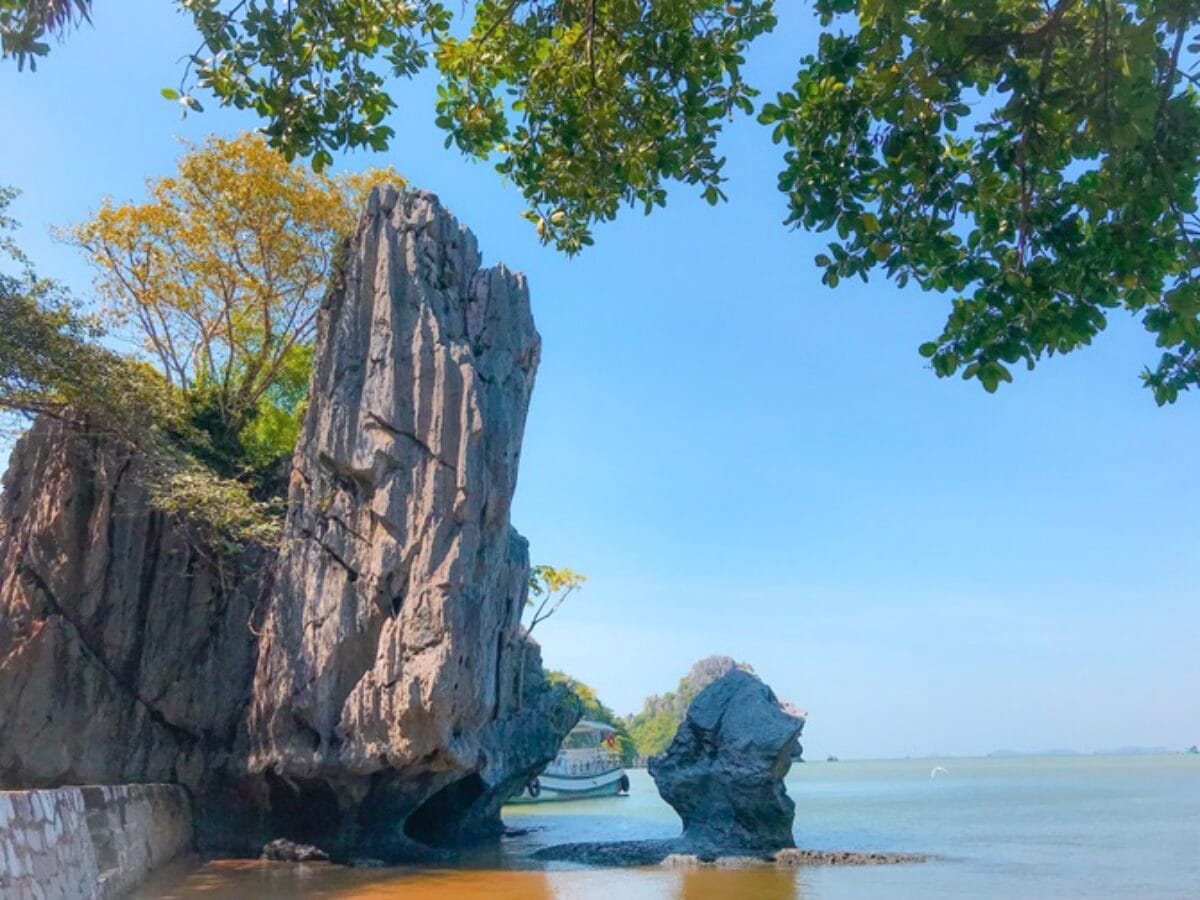
Then there is Thach Dong. Stone Cave Swallowing Clouds. The name sounds metaphorical until you stand before it. A colossal limestone tower rises abruptly from the plain, eighty meters of stone solitude. Climbing inside feels like entering a myth rather than a mountain. Stalactites form creatures and faces. Locals will point out the shape of a giant, a maiden, a bodhisattva. This is where legend insists that Thach Sanh once lived, where childhood stories stretch their limbs and breathe again.
Halfway up, the view opens unexpectedly. Ha Tien shrinks to a toy town. Cambodian villages appear along the border. A few steps further and you reach the Xa Xia border gate, where countries exchange glances across a modest checkpoint. Few places make geography feel so intimate.
Two kilometers on, Da Dung Mountain waits with a different temperament. Known as Chau Nham Lac Lo, the mountain of jeweled rocks where birds once gathered, it rises to eighty three meters, flat topped, honeycombed with caves. Inside, limestone formations gleam faintly like old pearls. The air smells cool, mineral, ancient. This is a mountain that rewards curiosity rather than speed.
Da Dung sits only six kilometers from Ha Tien center, yet feels far removed from ordinary time. Exploring its caverns is like reading footnotes to history, the parts left out of textbooks because they resist summary.
Eventually, Ha Tien leads you to water. Mui Nai Beach, once known as Loc Tri Thon Cu, opens wide and forgiving. Over a kilometer of gentle shoreline curves along the town, shaded by coconut palms. The sea here is unexpectedly clear for the Mekong Delta region, calm enough for unhurried swimming, friendly enough for families.
In the late afternoon, small fishing boats return with their modest harvest. Squid, shrimp, fish still tasting of salt. Restaurants along the beach will cook whatever you choose, simply, honestly. Prices are reasonable. The pleasure is disproportionate. During spring, seabirds wheel overhead, and purple wildflowers bloom on Nai Vang Hill, turning the entire scene faintly surreal.
Mui Nai also understands modern travelers. A compact water park hugs the shoreline, allowing children to exhaust themselves happily while adults reclaim the lost art of doing nothing.
Ha Tien is best explored slowly, ideally with a local tour guide who understands that itineraries are suggestions, not commandments. A well designed Ha Tien tour product links Binh San at sunrise, Tam Bao in the quiet hours, Thach Dong before noon clouds lift, Da Dung in the soft afternoon, and Mui Nai at dusk when the sea turns metallic.
Accommodation matters here, because Ha Tien invites longer stays than planned. Hotels in Ha Tien center offer practical comfort, easy access to markets, river views, and early morning street life. Look for properties that provide spacious rooms, attentive local staff, reliable transport services, and guidance on cross border travel if Cambodia tempts you next.
The benefits of staying centrally are immediate. You wake early to temple bells. You walk to breakfast stalls serving rice noodles and strong coffee. You return midday to rest before setting out again. Everything feels stitched together.
Ha Tien does not shout for attention. It does something far more persuasive. It waits. And once you arrive, it makes leaving feel like a small betrayal. This is a town that understands beauty not as spectacle, but as continuity. Five scenes remain. They are enough to remind us that travel is not about how many places we see, but how deeply one place sees us back.
Go now. Before you hear about it from everyone else.
Ha Tien travel guide, Ha Tien Ten Scenes tour, Kien Giang cultural travel, Ha Tien scenic spots, Southern Vietnam heritage tour, Ha Tien border town travel, Mui Nai Beach travel, Thach Dong cave tour, Binh San historical site, Ha Tien temple tour, Vietnam poetry landscapes, Ha Tien itinerary, Kien Giang tourism, Ha Tien hotel guide, Vietnam off the beaten path travel