
Narita Japan Walking Guide – Temples Eel Rice and Edo Streets
Many travelers see Narita only through the windows of an airport terminal. Planes land, passengers transfer trains, and the city becomes little more than a logistical waypoint.
That is a mistake.
Ten minutes away from Narita International Airport lies a small historic district where the rhythm of Japan slows dramatically. Wooden buildings lean toward narrow streets. Restaurant chefs prepare eel in full view of pedestrians. Pilgrims move quietly toward one of the country’s most visited Buddhist temples.
This compact area contains layers of history stretching from the Edo period to modern Japan.
For planners building a short cultural stop before a flight—or a half-day exploration after arrival—Narita offers something rare: a walkable gateway into traditional Japanese life.
Quick Summary Table
| Category | Details |
|---|---|
| Destination | Narita Historic Area |
| Location | Narita, Chiba Prefecture, Japan |
| Distance from Airport | ~10 minutes by train or bus |
| Walking Route | Narita Station → Omotesando Street → Naritasan Temple |
| Historic Landmark | Naritasan Shinsho-ji Temple |
| Temple Founded | Year 940 |
| Visitors Per Year | About 13 million |
| Famous Food | Unagi eel rice |
| Cultural Streets | Omotesando shopping street |
| Nearby Shopping | Aeon Mall Narita |
The Edo Roots of Narita
During the Edo period (1603–1868), Narita developed as both a pilgrimage center and a trading town. Samurai, merchants, and travelers passed through the area on their way to temples and markets.
Today that legacy still shapes the town’s layout.
From Narita Station, nearly every cultural route begins at the transport hub where buses and trains converge. Step outside the station and the city center unfolds immediately.
But instead of rushing to the temple, planners should slow down.
The most interesting part of Narita is the journey between the station and the temple itself.
Omotesando – The Street That Connects Everything
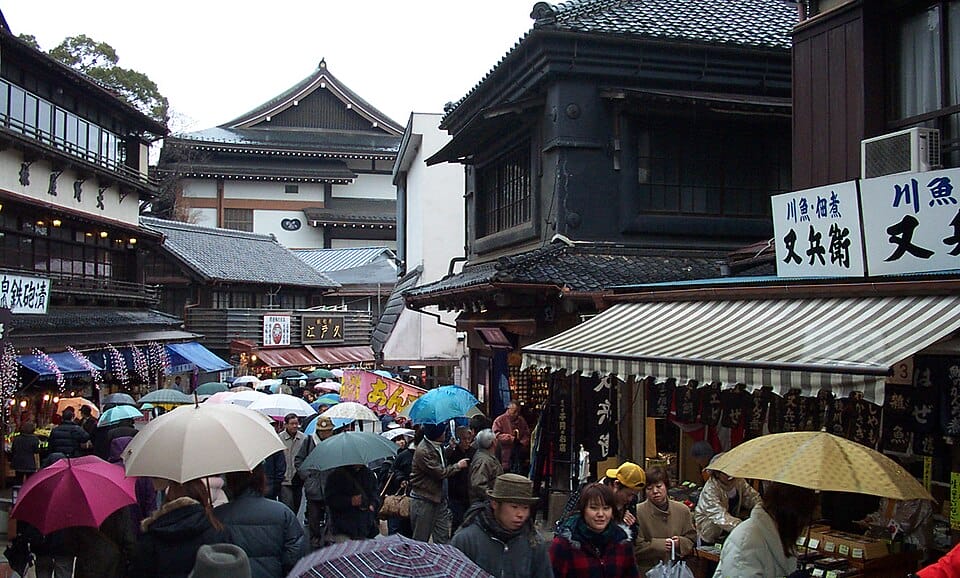
The historic route to the temple is Omotesando Street, a charming road stretching more than one kilometer.
Narita Omotesando Street acts as a cultural corridor linking the modern train station with the thousand-year-old temple complex.
The street curves gently uphill, similar to the winding slopes often found in parts of Kyoto. On both sides stand low wooden buildings housing restaurants, souvenir shops, and small family businesses.
Some stores sell dried seafood—shrimp, fish, and squid hanging neatly from racks. Others display fresh fish in water tanks placed directly on the sidewalk.
This detail hints at the town’s historic connection to fishing communities.
Yet the real culinary icon here is something else.
The Famous Dish of Narita – Unagi
Narita is synonymous with unagi, or grilled eel.
Restaurants line Omotesando Street, and many prepare the dish in full view of pedestrians.
Chefs move with remarkable speed:
-
catching live eels from water tanks
-
cleaning and filleting them
-
skewering pieces on bamboo sticks
-
grilling them over charcoal
The finished dish—eel served over rice with teriyaki sauce—is known throughout Japan.
In Narita, however, the meal often includes an additional specialty: clear eel soup.
The broth is delicate yet aromatic, containing carefully cleaned eel innards that deliver a surprisingly rich flavor without any fishy smell.
Local diners treat this soup as a quiet masterpiece of Japanese culinary technique.
Still, experienced travelers usually save this meal for a relaxed lunch rather than an early morning snack.
The Temple That Defines the Town
At the end of Omotesando stands the city’s spiritual center:
Naritasan Shinsho-ji Temple
Founded in 940, the temple remains one of Japan’s most significant pilgrimage sites.
The name itself carries symbolic meaning:
-
Naritasan refers to Mount Narita
-
Shinsho-ji translates roughly to “Temple of Victory”
Originally built to commemorate a military victory, the complex expanded across centuries into a large spiritual campus.
Today it receives approximately 13 million visitors annually.
Pilgrims, tourists, and school groups all pass through its gates.
A Temple Complex Built Across Centuries
Naritasan is not a single structure. It is a layered architectural record of Japanese history.
Important landmarks include:
-
Komyo-do Hall (1701)
-
Three pagodas built in 1712, each about 25 meters tall
-
Niomon Main Gate (1830)
-
Naritasan Park opened in 1928
-
Great Peace Pagoda built in 1984
Walking through the complex feels like browsing an encyclopedia of Buddhist architecture.
School groups often visit the temple with guides. Students gather in small clusters beneath temple roofs while instructors explain historical and religious traditions.
It is history class in the open air.
Naritasan Park – A Quiet Forest Inside the Temple Grounds
Behind the temple lies an expansive green space:
Naritasan Park
The park covers more than 16 hectares and feels closer to a forest than a city garden.
Stone paths weave beneath dense trees. Traditional rock gardens appear between slopes and ponds. Cherry trees line long walkways that become particularly striking during blossom season.
The design follows a classic East Asian landscape philosophy—nature arranged carefully but appearing almost wild.
Walking here can be slightly disorienting. The paths twist through dense greenery, and visitors sometimes feel briefly lost.
That sense of wandering is intentional.
The park invites slow movement and quiet reflection.
A Modern Contrast – Aeon Mall Narita
After temple visits and lunch on Omotesando, many travelers return toward the airport.
Yet one more stop often appears on the itinerary:
Aeon Mall Narita
Located near the temple area, the mall contains roughly 150 shops selling everything from books and fashion to kitchen tools and electronics.
The complex also houses a cinema:
Humax Cinema Theaters
Travelers leaving Japan frequently stop here to spend remaining yen before departing.
Even though Narita Airport offers extensive duty-free shopping, some visitors note that prices in Aeon Mall can be lower.
The mall also features an interesting section of discounted products—display items, test products, or lightly used goods that still meet Japanese quality standards.
For travelers interested in everyday Japanese design, browsing here can be surprisingly informative.
Things the Media Doesn’t Tell You
Travel coverage often reduces Narita to one idea: an airport city.
The reality is more nuanced.
1. Narita is a pilgrimage town first, an airport hub second
Long before international flights arrived, Narita existed because of its temple. Pilgrims traveled here during the Edo period, creating the merchant streets that still survive today.
2. The temple complex is larger than many visitors expect
Naritasan is not just one hall but a large campus of buildings from multiple historical eras.
Allow time to explore the park behind the temple.
3. Omotesando is part culinary theater
Watching chefs prepare eel is not simply cooking—it is performance. Many restaurants intentionally place preparation areas near the street so visitors can observe the craft.
4. Shopping near the airport is strategic
Some travelers schedule time at Aeon Mall before departure specifically to spend leftover yen and purchase practical Japanese goods.
Planning that stop avoids the rush of airport shopping.
Cultural Extensions Around Narita
Narita also connects to several nearby historic destinations.
Travelers with extra time sometimes continue toward:
-
Boso no Mura Open Air Museum – a reconstructed Edo-period village
-
Sawara – canal town with preserved historic houses
-
Sakura City – former samurai center and home to the National Museum of Japanese History
These locations extend the cultural narrative beyond Narita itself.
Community Observations
Travel forums and visitor communities often describe Narita in unexpectedly emotional terms.
One traveler wrote:
“I expected a quick airport transfer. Instead I found a temple town.”
Another frequent comment about Omotesando reads:
“Walk slowly. The street changes every hundred meters.”
These small observations capture the essence of Narita: a place that rewards curiosity rather than speed.
Narita Beyond the Airport – Temples Markets and Traditional Streets.
Narita Japan travel, Naritasan temple guide, Omotesando Narita street, Narita eel restaurants, Narita walking itinerary, Narita cultural district, Narita historic streets, Narita temple pilgrimage, Narita park garden, Narita airport stopover, Narita shopping guide, Aeon mall Narita, Narita Edo heritage, Narita Japan temples, Narita travel planner
