
Phuket Old Town Walking Guide – Streets, Temples, Food and Colonial Houses
Most travelers arrive in Phuket expecting turquoise water and long beach afternoons. The island delivers that easily. Yet several kilometers inland lies a quieter landscape: narrow streets, pastel colonial facades, temples hidden behind old gates, and family shops that have survived three generations of change.
This district — often called the historic center of Phuket Town — reveals a version of the island shaped by Chinese merchants, Malay traders, European mining companies, and Thai culture.
The rhythm here is slower. Instead of surfboards and beach bars, the soundtrack might be jazz drifting from a sidewalk café while someone next door bargains over batik fabric.
Walking through the old quarter is not just sightseeing. It is an encounter with the island’s layered identity.
Quick Summary Table
| Category | Details |
|---|---|
| Destination | Phuket Old Town |
| Location | Phuket Town, Thailand |
| Walking Distance | ~2 km historic district |
| Time Needed | Half-day exploration |
| Main Streets | Thalang Road, Dibuk Road, Phangnga Road |
| Cultural Sites | Serene Light Temple, Jui Tui Temple |
| Architecture | Sino-Portuguese shophouses |
| Historic Mansion | Baan Chinpracha (1903) |
| Food Highlights | Kanom Jeen noodles, Moo Hong pork stew |
| Best Way to Explore | Walking |
Why Walking Changes Everything
Many visitors arrive by tuk-tuk, expecting a quick sightseeing loop. It works for efficiency, but it misses the essence of the neighborhood.
The historic district stretches roughly two kilometers across six streets and two small alleys. Walking reveals details that vehicles glide past: carved wooden shutters, narrow courtyards, and balconies that once signaled wealth during Phuket’s tin-mining era.
Start your walk near the tourism office on Thalang Road, where maps titled Phuket Town Treasure are sometimes available.
From there, the route naturally unfolds.
Streets gradually transition from colorful shop houses to temples, bakeries, and antique stores.
Lanterns begin appearing overhead as evening approaches.
Architecture That Defines the Streets
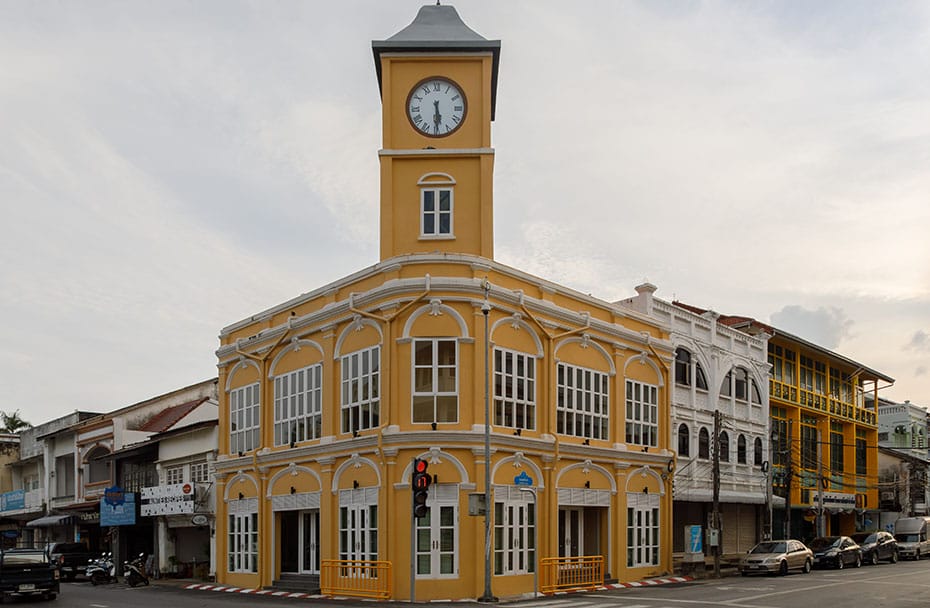
The most distinctive feature of the district is its Sino-Portuguese architecture.
These buildings combine southern Chinese shop-house structures with colonial Portuguese influences.
The result is a unique style:
-
pastel façades
-
arched walkways
-
wooden shutters
-
long narrow interiors connecting street to courtyard
Walking along Thalang Road and Dibuk Road feels almost like stepping into another century.
Art galleries occupy old homes. Antique shops share walls with bakeries. Family-owned fabric stores sell patterned textiles similar to Malaysian batik.
One of the oldest continuing businesses is Guan Choon Tong, a herbal shop that has served the neighborhood for generations.
These storefronts illustrate something travel brochures rarely explain: Old Town is still a living neighborhood, not a preserved museum.
A Mansion from the Tin Mining Era
One building stands out for its historical importance.
Baan Chinpracha was built in 1903 and remains one of the few traditional mansions open to visitors.
The house reflects the wealth accumulated during Phuket’s tin-mining boom.
Inside, spacious halls display antique furniture imported from Europe and China. The layout centers around a courtyard that allows tropical airflow — a practical adaptation to Phuket’s humid climate.
Behind the mansion sits a quiet garden filled with tropical plants, a reminder of the Thai influence embedded within this Chinese-European structure.
The house represents the hybrid identity that shaped the island.
The Memory of Tin Mining
The prosperity that built these houses came largely from tin.
Areas such as Phuket Laguna were once mining sites. Today they are luxury resort zones, but fragments of the island’s industrial past remain visible if you know where to look.
Abandoned pits became lagoons. Workers’ settlements turned into neighborhoods.
Understanding this economic history helps explain why Phuket’s old quarter developed such a diverse cultural mix.
Streets That Come Alive at Night
Daytime exploration highlights architecture, but nighttime introduces atmosphere.
Red Chinese lanterns illuminate the streets, reflecting softly against colorful facades.
Street cafés spill onto sidewalks.
Music — sometimes jazz — floats from small venues where travelers sip milk tea or iced coffee.
The change in mood is subtle but powerful. A street that felt historical in daylight becomes social and vibrant after sunset.
Temples Hidden in Plain Sight
Among the most fascinating places in the district are temples that many travelers walk past without noticing.
One example is Serene Light Temple on Phangnga Road.
The temple sits quietly between buildings and receives little publicity, but locals visit to perform rituals and draw fortune sticks for predictions about the future.
Its location — tucked into a narrow passage — illustrates how spiritual spaces in Southeast Asia often coexist seamlessly with everyday commercial life.
A Festival that Transforms the Neighborhood
Another religious landmark is Jui Tui Shrine.
In October, the temple becomes the center of the famous Phuket Vegetarian Festival.
For nine days the surrounding streets fill with:
-
vegetarian food stalls
-
drum performances
-
fireworks ceremonies
-
traditional ritual demonstrations
Participants dressed in ceremonial clothing perform extreme acts such as walking across hot coals. The spectacle attracts international attention, yet the deeper purpose remains spiritual purification.
Food Culture in the Old Quarter
Phuket’s culinary scene reflects the island’s cultural diversity.
Walking through the old town reveals influences from:
-
Fujian Chinese cuisine
-
Malay cooking
-
Indian spices
-
European café traditions
Some dishes worth trying include:
Kanom Jeen – rice noodles served with rich curry sauces.
Moo Hong – slow-braised pork with garlic and pepper, rooted in Fujian Chinese cooking.
Several well-known places appear along the main streets:
-
China Inn Cafe – historic café on Thalang Road
-
La Romantica Restaurant – Italian restaurant
-
Siam Bakery – toasted bread and coffee
Street vendors are equally important. Small stalls often serve the most authentic local snacks.
Getting There
Most visitors arrive via Phuket International Airport.
A local bus connects the airport to Phuket Town. From the historic center, travelers can take songthaew trucks or tuk-tuks along Ranong Road toward the island’s beaches.
Things the Media Doesn’t Tell You
Travel media often frames Phuket as a beach destination. The historic town receives far less attention, even though it tells a deeper story about the island.
Several practical realities are rarely mentioned.
1. The old town is compact but layered
The district is small enough to walk in half a day, yet its cultural influences are complex. Chinese migration, Malay trade routes, and European mining companies all shaped the streets you see today.
2. Some buildings are still private homes
Not every colorful façade is a café or gallery. Many belong to families who have lived there for decades. Respectful exploration matters.
3. Walking is essential
Motorized tours pass quickly through the main streets. Walking allows time to notice architectural details and small businesses that keep the neighborhood alive.
4. Festivals change everything
During the Vegetarian Festival, normal routines disappear. Streets fill with processions, food stalls, and ritual ceremonies. Planning ahead becomes essential.
A Planner’s Route Through Old Town
For travelers designing a half-day itinerary, the most efficient route looks like this:
-
Start on Thalang Road with a walking map.
-
Explore art galleries and fabric shops along the street.
-
Continue to Dibuk Road for architecture and cafés.
-
Visit Baan Chinpracha for historical context.
-
Stop at Serene Light Temple for cultural insight.
-
Walk toward Jui Tui Shrine if visiting during festival season.
-
End with dinner at a café or street stall before sunset.
The route covers roughly 2 kilometers yet captures the core identity of Phuket’s old quarter.
Community Voices
Travel communities and local residents often describe the district in practical terms rather than romantic language.
One traveler summarized it simply:
“The beaches explain why people come to Phuket. The old town explains why people stay longer.”
Another comment often repeated in local forums highlights the architecture:
“Walk slowly. Every block has a different color palette.”
Those observations capture the spirit of the neighborhood better than any brochure.
Phuket Beyond Beaches – A Walking Route Through Old Town Culture.
Phuket old town walk, Phuket town travel guide, Phuket architecture streets, Sino Portuguese Phuket, Phuket cultural district, Thalang road Phuket, Phuket heritage houses, Phuket temples guide, Phuket vegetarian festival, Phuket walking itinerary, Phuket historic district, Phuket local food guide, Phuket town cafes, Phuket cultural attractions, Phuket travel planner
