
12 Places Where Sunset Becomes the Main Event
A Planner’s Guide to the World’s Most Photographed Evenings
There is a moment in travel when movement stops. Cameras lower. Conversations pause. The sky takes over.
Sunsets are among the few experiences that consistently reshape travel itineraries. Photographers chase them. Writers describe them. Travelers quietly wait for them.
But planning a trip around a sunset requires more than simply arriving before dusk. Geography, landscape orientation, cultural context, and even seasonal migration patterns influence what you actually see.
Below is a strategic overview of 12 global locations where sunset is not just scenery—it is the centerpiece of the destination.
Quick Travel Summary Table
| Destination | Country | Landscape Type | Best Viewing Context | Access |
|---|---|---|---|---|
| U Bein Bridge – Mandalay | Myanmar | Lake + teak bridge | Silhouettes over Taungthaman Lake | Flights to Mandalay |
| Maasai Mara National Reserve | Kenya | Savanna grassland | Wildlife migration season | 45-minute flight from Nairobi |
| Uluru & Kata Tjuta | Northern Australia | Desert rock formations | Color-changing sandstone domes | Flights to Northern Territory |
| Aci Trezza – Catania | Italy | Mediterranean fishing village | Basalt Cyclops Islands | Bus or train from Catania |
| Grand Canyon – Arizona | United States | Canyon landscape | Hopi Point layered rock view | Bus/train from Phoenix, Flagstaff, Las Vegas |
| Dubai Desert & Jumeirah Beach | UAE | Sand dunes + coastline | Camel desert view or beach skyline | Dubai international access |
| West Lake – Hangzhou | China | Lake + historic pagoda | Leifeng Pagoda silhouette | Flights to Hangzhou |
| Guanshan – Kenting | Taiwan | Coastal mountain | Hengchun Peninsula panorama | Flights to southern Taiwan |
| Oia – Santorini | Greece | Cliffside town | Aegean Sea horizon | Flights from Athens |
| Phnom Bakheng – Angkor | Cambodia | Temple hilltop | Angkor skyline sunset | Access via Siem Reap |
| Maui | United States | Tropical coastline | Beach horizon sunsets | Flights to Hawaii |
| Rapa Nui – Easter Island | Chile | Pacific island archaeology | Moai statues at dusk | Remote Pacific flights |
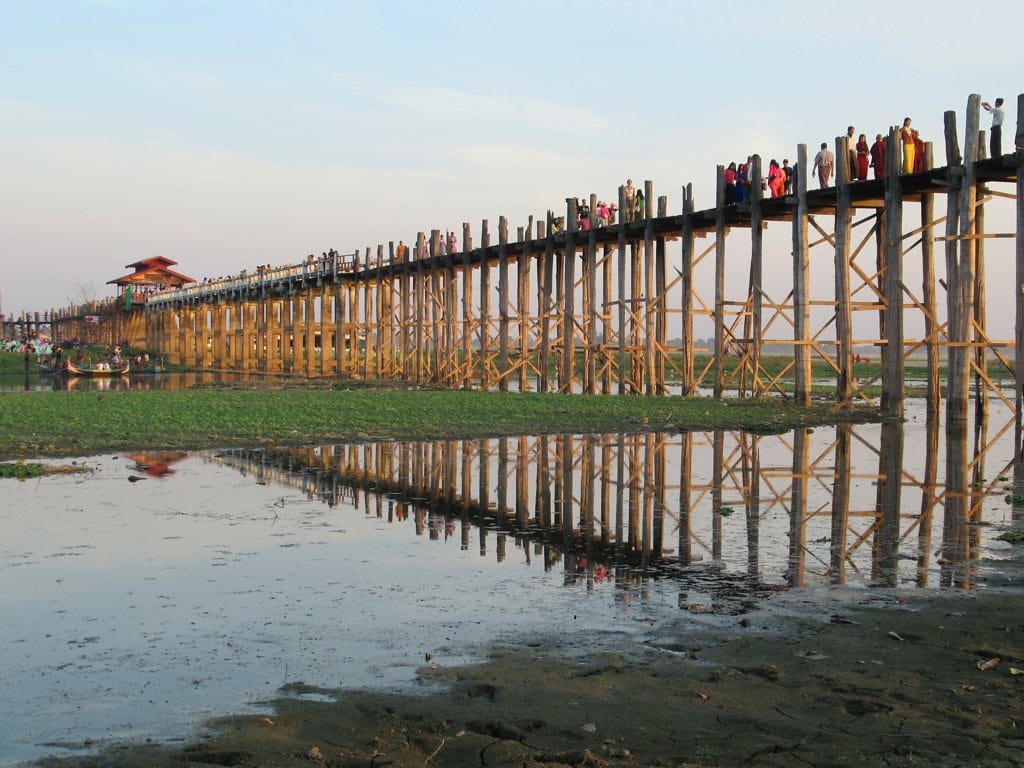
1. U Bein Bridge – Mandalay, Myanmar
Stretching 1.2 km across Taungthaman Lake, U Bein Bridge remains the longest teakwood bridge in the world.
During the day, monks, cyclists, and villagers cross the bridge in a steady flow. But toward evening, the rhythm changes. Movement slows. Boats drift under the bridge as the sky turns orange.
From a planning perspective, sunset works here because of silhouette geometry. The long horizontal bridge creates a strong visual line against the water.
A travel writer once described the moment this way:
“Sunsets become memorable when human movement intersects landscape.”
And U Bein delivers precisely that.
Access strategy:
Daily flights connect major cities in Myanmar to Mandalay, followed by a short drive to the lake.
2. Maasai Mara National Reserve – Kenya
Sunset in Maasai Mara is less about color and more about scale.
As the sun drops toward the horizon, the savanna turns deep red. Dust rises from migrating herds. The landscape stretches uninterrupted in every direction.
The best period to experience this moment is July to October, when the zebra, Thomson’s gazelle, and wildebeest migrations move between Mara and Serengeti.
In this setting, sunset becomes part of the wildlife narrative.
Planner insight:
Safari lodges and tent camps are positioned specifically to maximize sunset views across open plains.
Access:
A 45-minute flight from Nairobi brings visitors directly to the reserve.
3. Uluru and Kata Tjuta – Northern Australia
Few landscapes transform under changing light like Uluru.
The sandstone monolith rises 348 meters above the desert floor, stretches 5 km long, and has a circumference of 9.4 km.
Nearby, Kata Tjuta (also called The Olgas) forms a cluster of 36 massive domes located 36 km west of Uluru.
Both sites are part of a UNESCO-recognized national park.
At sunset, the rock formations shift colors—from rust red to purple to deep brown.
It is one of the clearest examples of geology shaping a sunset experience.
Access:
Flights from major Australian cities reach the Northern Territory.
4. Aci Trezza – Catania, Italy
On Sicily’s eastern coast sits Aci Trezza, a fishing village tied closely to Italian literary history.
The setting appeared in the 1881 novel “I Malavoglia” (The House by the Medlar Tree) by Giovanni Verga.
Offshore lies the Cyclops Islands, a chain of basalt columns rising from the sea. Local legend claims they were thrown by the giant Polyphemus at Ulysses.
As sunset approaches, the Mediterranean reflects the golden light across these dark volcanic rocks.
The contrast—black basalt against glowing water—creates one of the Mediterranean’s most distinctive evening scenes.
Access:
Aci Trezza sits 10 km from Catania and can be reached by bus or train.
5. Grand Canyon – Arizona, United States
The Grand Canyon is vast even by American landscape standards.
The canyon extends roughly 445 km long and 29 km wide.
Sunset reveals its defining feature: layered geology.
At Hopi Point, sunlight falls across stacked rock layers that represent millions of years of Earth’s history.
Instead of a single horizon, you see multiple shadow lines forming across the canyon walls.
Access:
Buses and trains connect from Phoenix, Flagstaff, and Las Vegas.
6. Dubai Desert and Jumeirah Beach – United Arab Emirates
In Dubai, sunset happens in two distinct environments.
Option one:
Ride a camel across desert dunes as the sun sinks into the sand-colored horizon.
Option two:
Watch the sunset from Jumeirah Beach, where the skyline forms a dramatic urban silhouette.
The desert experience highlights Arabian landscape traditions, while the beach setting emphasizes modern Dubai’s coastal geometry.
7. West Lake – Hangzhou, China
Few urban landscapes combine mythology and architecture like West Lake in Hangzhou.
One focal point during sunset is Leifeng Pagoda, illuminated by the final light of day.
The pagoda is tied to the famous Legend of the White Snake, where a mythical figure was said to be imprisoned there for decades.
Historically:
-
Original pagoda built 975
-
Collapsed 1924
-
Rebuilt 2002
As the sun lowers behind the lake, the pagoda’s silhouette reflects on the water.
Access:
Daily flights connect major Chinese cities to Hangzhou.
8. Guanshan – Kenting National Park, Taiwan
At 152 meters high, Guanshan offers the highest sunset viewpoint in Kenting National Park.
The view extends across the Hengchun Peninsula, an area notable for its lack of highways and railways—rare for a modern coastal region.
Because of this limited development, the sunset panorama remains largely unobstructed.
The park is open 11:00 to 19:00, aligning perfectly with sunset viewing hours.
9. Oia – Santorini, Greece
Few towns are as closely associated with sunset as Oia.
Perched on cliffs above the Aegean Sea, the town faces west—ideal orientation for sunset viewing.
Most travelers plan their evening around restaurants with sea-view terraces, where dinner and sunset happen simultaneously.
Access:
Daily flights connect Athens to Santorini.
10. Phnom Bakheng – Angkor, Cambodia
Located roughly 1.5 km from Angkor Wat, Phnom Bakheng is a hilltop temple known for its panoramic sunset views.
The elevated position allows visitors to see the Angkor landscape stretching across the horizon.
Because of this vantage point, sunset here reveals both temple architecture and forest canopy in the same frame.
Access:
Travelers reach Siem Reap by bus or plane, then continue to Angkor.
11. Maui – Hawaii
Sunset in Maui follows a classic Pacific formula:
-
Ocean horizon
-
White sand beaches
-
Open skies
With minimal obstructions, the sun appears to drop directly into the sea.
This simple geometry explains why Hawaii consistently ranks among the best locations for ocean sunsets.
12. Rapa Nui (Easter Island) – Chile
Few sunset locations combine archaeology and geography like Rapa Nui.
Located roughly 3700 km from mainland Chile, the island sits deep in the Pacific Ocean.
The most iconic scene occurs when sunlight falls across the Moai statues—massive stone figures created by the ancient Rapa Nui civilization.
These statues face inland with their backs toward the ocean.
At sunset, the light outlines their profiles, creating one of the most recognizable silhouettes in world travel.
Things the Media Doesn't Tell You
Sunset destinations often appear effortless in travel photography. In reality, planning the experience requires careful timing and positioning.
Crowds:
Places like Oia or Phnom Bakheng can become extremely crowded at sunset. Arriving early is essential.
Orientation matters:
Not every viewpoint faces west. Some locations require specific viewing platforms.
Weather unpredictability:
Cloud cover can obscure sunsets even at famous locations.
Seasonal variables:
At Maasai Mara, the dramatic sunset scenes are amplified during migration season—but the wildlife movement is not guaranteed daily.
Travel writers often emphasize beauty. Planners focus on logistics.
And when both perspectives align, sunset becomes more than scenery—it becomes a moment worth traveling for.
Sunset Tourism – 12 Destinations Where the Last Light Shapes the Entire Journey.
world sunset destinations, best sunset spots, U Bein Bridge sunset, Maasai Mara sunset safari, Uluru sunset view, Aci Trezza sunset Sicily, Grand Canyon sunset point, Dubai desert sunset, West Lake Hangzhou sunset, Guanshan Kenting sunset, Oia Santorini sunset view, Phnom Bakheng sunset Angkor, Maui beach sunset, Easter Island sunset moai, global sunset travel
